
Why peeing a little when you sneeze isn't just what happens
Let's start with what we hear in the clinic almost every week.
A woman in her thirties or forties (sometimes older, sometimes younger) tells us, slightly apologetically, that she leaks a bit when she sneezes. Or when she coughs. Or jumping on the trampoline with her kids. Or running. Or laughing too hard. She's usually quick to add that it's not a big deal, that she's just used to it, that it's just what happens after kids.
It's not. And it doesn't have to.
What's actually going on
Urinary incontinence affects roughly one in three women in New Zealand at some point in their lives. It is genuinely common. But common and normal are not the same thing.
The most frequent type we see is stress urinary incontinence: small leaks that happen when there's a sudden increase in pressure on your bladder. A sneeze, a cough, a jump, a laugh, lifting something heavy. It happens because the muscles of your pelvic floor (the ones that should be supporting your bladder and closing off your urethra under load) aren't doing their job properly. Either they're too weak, too tight, too uncoordinated, or some combination of all three.
The other common type is urge incontinence: the sudden, strong need to go that has you sprinting to the bathroom and sometimes not making it. This one is more about how your bladder and brain are talking to each other than it is about muscle strength.
Most women have a mix.
Why "just doing Kegels" often doesn't work
A lot of women have tried pelvic floor exercises off the back of a midwife's advice, a magazine article, or a quick YouTube video. And many find it makes no real difference.
There are a few reasons for that.
First, the cue most people are given (squeeze as if you're stopping a wee) often produces the wrong muscle contraction. A surprising number of women, when assessed, are actually contracting their pelvic floor in the wrong direction or pushing down instead of lifting up.
Second, weakness isn't always the problem. For many women, the pelvic floor is too tight, gripping all the time, with no capacity to actually contract on demand because it's already maxed out. Doing more squeezing in this case makes things worse, not better.
Third, the pelvic floor doesn't work in isolation. It works with your breathing, your deep abdominal muscles, and the muscles around your hips and back. If any of those aren't doing their part, the pelvic floor can't compensate forever.
This is why a proper assessment, with someone who actually knows what they're doing, matters so much. The exercises that fix the problem are different for different people.
What treatment actually looks like
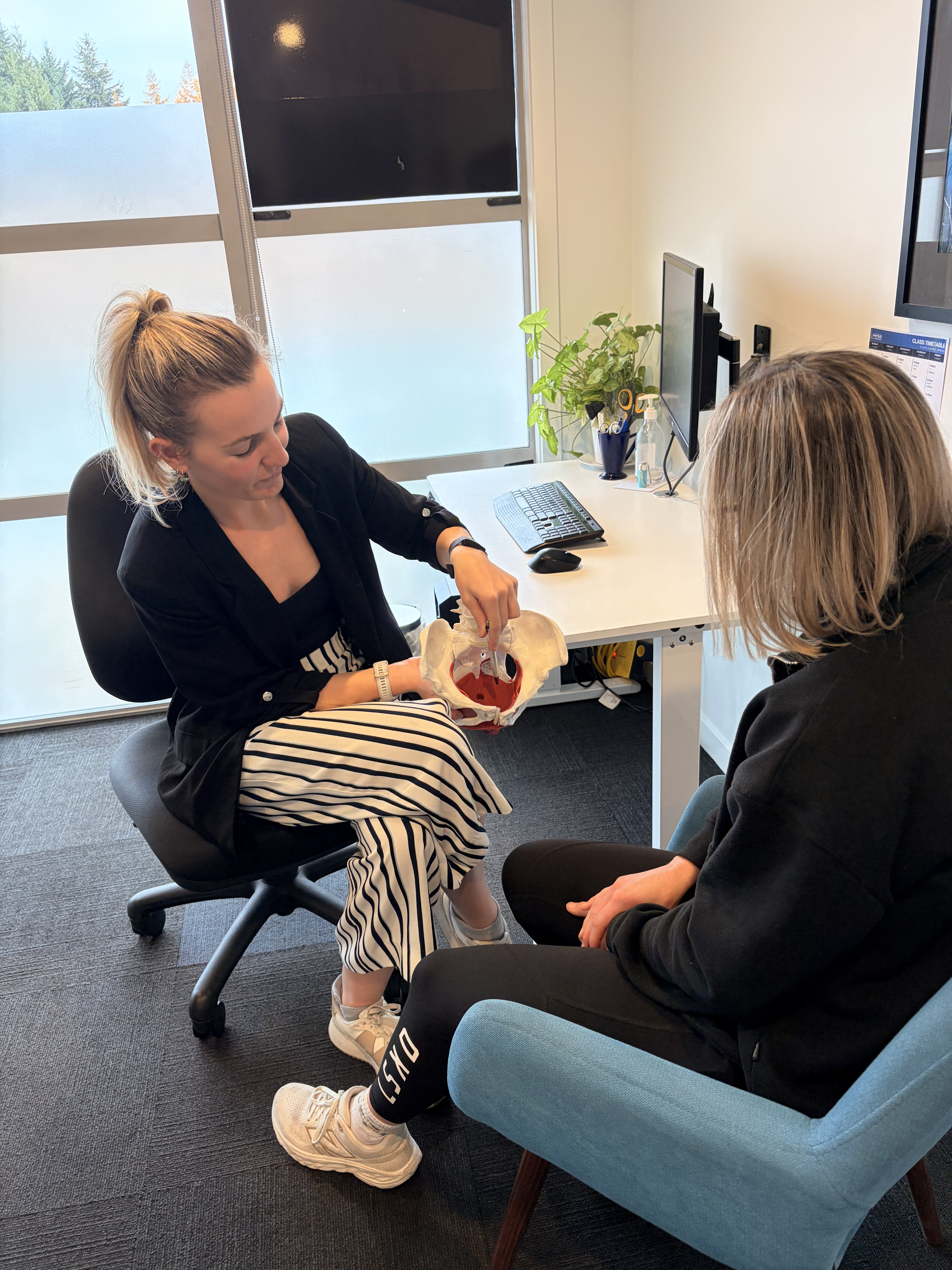
A first appointment is usually 60 minutes. We take a thorough history, talk about your goals (whether that's getting back to running, jumping on the trampoline with your kids, or just sneezing without a thought), and then we do an examination if you're happy to. The examination is the part most women dread, and almost universally tell us afterwards was nothing like they expected. It's discreet, respectful, and gives us the clearest picture of what's actually happening so we can build the right plan.
From there, most women need somewhere between three and eight appointments over a few months. We'll give you exercises that are specific to your situation. We'll teach you how to do them properly. We'll progress them as you get stronger. And we'll usually look at the other factors too: how you breathe, how you lift, how you manage your bladder habits.
The vast majority of women we see fully resolve their leaking. Not "manage it", not "get used to it". Fully resolve it.
What if it's been years?
It doesn't matter. We routinely see women who've had leaking for ten, fifteen, twenty years. The body is remarkably responsive once the right work is being done. Time is not the barrier most people think it is.
What about menopause?
Menopause changes things. The hormonal shifts thin the tissues, weaken the muscles, and often make a previously small problem suddenly much bigger. The good news is that pelvic health physiotherapy is just as effective during and after menopause, sometimes alongside topical hormone therapy that your GP can prescribe. The two work very well together.
If you've been quietly putting up with this
You don't have to. There's no good reason to keep accepting it, no matter how long it's been going on, no matter how mild it seems. Even small leaks tend to get worse with time, not better, especially through menopause.
If you'd like to talk it through without committing to a full appointment, we offer a free 15-minute consultation with our pelvic health physios. It's discreet, no pressure, and the only goal is to help you decide if this is something we can help with. In person or over the phone, whichever feels easier.
Give us a ring on 03 443 1711, book online, or pop in and have a chat with Karen at reception.
You've put up with this for long enough.